
Saturday, September 16
 |
s always, we left at 6:00 AM to catch the 6:15 morning sunrise. On the equator, as we nearly were, sunrise and sunset do not change with the time of year, as they do in the northern or southern hemispheres. Neither do areas on the equator have seasons, as we know them. They have only wet and dry seasons. |
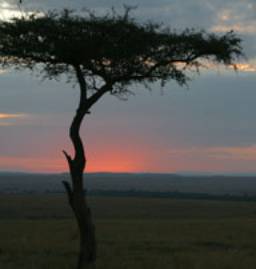
This morning’s sunrise was a soft one, but beautiful in its own way. The beginning of a new day is always beautiful.
The early morning light caused the grass to appear golden.
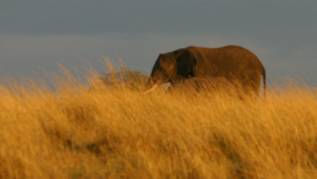
Notice the height of the grass compared to such a huge animal as an elephant. Keep in mind that when the wildebeest migration passes through, they can mow this grass to ankle height in a week. (That’s the height of our ankle; not an elephant’s).
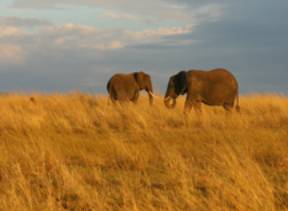
I think this picture illustrates the value of going to Africa. Almost all of us have seen animals like elephants and lions at a zoo, but to see them roaming around freely like this, in their land, where they are the owners and we are the guests, gives us an entirely different outlook. Best of all was to see them in their great numbers, as they were meant to be.
The elephants paid no attention to us, and just walked around our Land Rovers. Of course, we knew enough to be quiet, and not disturb them.

Because other visitors ahead of us had been well behaved (or escorted out of the park, I suspect), the animals were habituated to go about their natural behaviors, and even approached us with their young. Of course, you might say that an elephant fears no one, but smaller animals did this also.
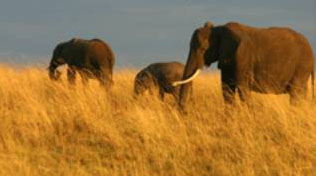
I especially liked the dark color of the elephants against the golden grasses.
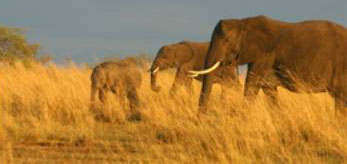
There were many elephants in this area.
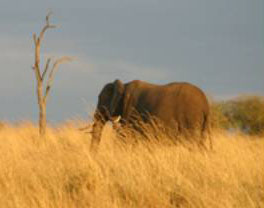
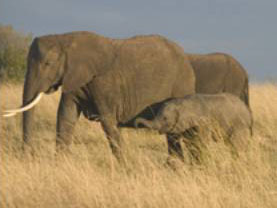
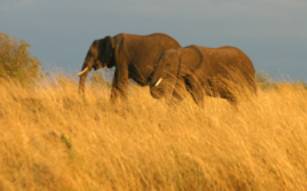
My favorite picture of this day, and perhaps of the entire trip is this one.

This area was not the same one we had visited earlier when we saw another herd of elephants. It was encouraging to know that there are still some alive to roam freely. It was a privilege to watch them.
 |
e headed next to a swampy area. It surprised me to learn that there even was a swampy area in such a dry savannah, but with both the Mara and the Talek Rivers running through the Mara Preserve it does make sense. |
The first bird we saw was the Black-headed heron.

Black-headed Heron, Ardea melanocephala
There were a number of interesting birds here.

Sacred Ibis, Threskiornis a. aethiopicus
Over the marsh flew a very large white bird with black on its wings, the Yellow-billed stork.

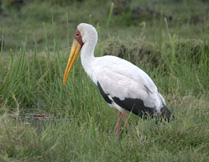
Yellow-billed Stork Mycteria ibis
In the river not far away we found this hippopotamus, doing what hippos do most of the day.

Hippopotamus
Back in the savannah again we came upon an unusual (to us) bird, the Black-bellied Bustard.

Black-bellied Bustard, Eupodotis m. melanogaster
Today was not a typical morning, but the wildlife was most interesting. Our next bird is considered to be one of the most beautiful raptors of all, the Bateleur. Its name came from the French word “bateleur” describing a tightrope walker using a balancing pole. This bird moves side-to-side during flight, appearing as the tightrope walker might.

Bataleur, Terathopius ecaudatus
Our driver was doing especially well at finding interesting wildlife for us today. He next found a bat-eared fox for us. It uses its large ears to detect flying insects by sound.

Bat-eared Fox, Otocyan megalotis

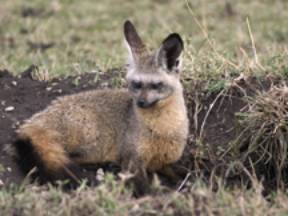
We saw no young at the Bat-eared fox’s den.
In the river itself, nothing seemed to disturb the hippos.
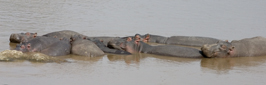
The hippos were not the only ones in the river. This huge crocodile was very much in evidence.

What was he waiting for?
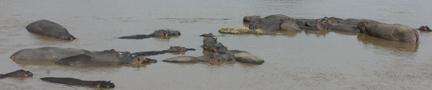
The river farther on, seemed full of hippos.
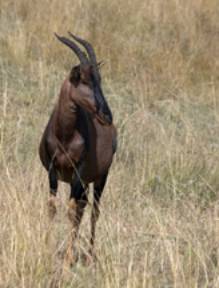
We found a group of adult topis, a beautiful member of the antelope family.

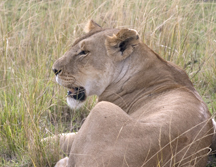
The Maasai Mara Reserve is noted for its large number of lions. Although this lioness is resting, she is very alert.
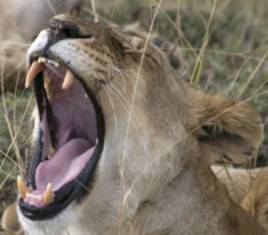
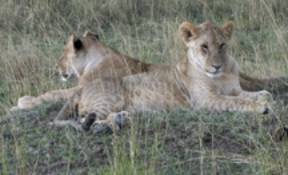
The cubs imitated the art of resting also.

It rained after these pictures were taken, so there were no sunset pictures.
 Click to return to Main Menu
 Click here for the story of the previous day
 Click here for the story of the following day
Click here to send Zoe an email.