
Introduction
 |
y long-range plans called for a photo safari to Kenya, Africa with Joe VanOs Photo Safaris in 2007. After placing my deposit and securing my place as number 42 on the waiting list, I forgot about it. Hardly had I returned from Patagonia in May, when an e-mail arrived announcing that due to a cancellation, there was now an open space on the 2006 African Safari. I had until tomorrow night to make my decision. |
I had not previously seriously considered this trip for 2006 because the chances of 41 people canceling their trip to make room for me seemed extremely remote. Later I learned that this was not the case. Actually a single woman had cancelled; so another single woman was needed to replace her. A couple could not go because there was only a single bed available, and it was a single woman who needed a roommate. I do know that a number of single women ahead of me declined the opportunity, fortunately for me.
This was considered “last minute” by travel standards, but I began reading as much as I could about Africa in general, and Kenya in particular. Little information was available. In telling people about my exciting plans to “travel to Africa,” it surprised me that almost no one asked me to what country I would go. Africa is a continent, after all.
After all my immunization shots, I felt like a walking pharmacy; but it was worth it.
Friday, September 8
 |
n September 8th, I gathered my one permitted bag to check, my properly weighed carry-on camera bag, and one personal item with mostly photo equipment. My brother, Adam, took me to the airport and after a rather long wait, I was actually ON MY WAY TO AFRICA!!! It sounded so daring to be going so far alone to a 3rd world country. |
The commuter flight to Newark, New Jersey was uneventful, and I found the international terminal, and KLM Royal Dutch Airlines, a partner of Continental Airlines. KLM is partner with Northwest Airlines, which in turn, are partners with Continental. The overnight flight to Amsterdam, Netherlands was also uneventful, thankfully.
Saturday, September 9
 |
msterdam had a very large, clean airport. There was a long layover scheduled here. I noticed that the flight attendants wore uniforms in a pretty shade of blue, possibly Delft blue. The KLM flight to Nairobi, Kenya was operated by KLM, but was also coded as Kenya Air. I felt better that the Dutch were the ones actually flying the plane. |
At the Kenya Airport it was good to recognize John Shaw, the leader of the Patagonia trip only a few months earlier. We were bused immediately to our five star Safari Park Hotel, but since it was already night again, we could see very little of the surroundings, and most of us were too tired to care.
The 55 participants and 5 leaders met for our “get acquainted dinner,” and went to bed as quickly as possible.
Sunday, September 10, 2006
|
t breakfast we were assigned the time to assemble for the bus ride to the airport, where small planes would take us to the Maasai Mara Intrepids Safari Camp, our home for the Safari. I was thankful to be assigned to the largest of the three small planes, because it had two engines, and my theory is that the more engines, the better. |

Kenya’s Capitol, Nairobi
We flew over Nairobi, the capitol of Kenya, and saw the several tall office buildings that marked the center of town. Then there was a line or possibly a fence, and on the other side were the slums. They were actually shacks, and even from the air we could see what a dismal place they were. There were no streets, no trees, no water, but people really did live there, and it was easy to see why missionaries are so badly needed.
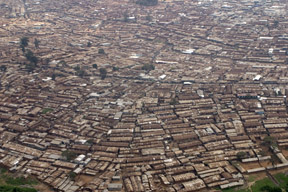
Nairobi’s slums
From the air it was easy to see the Great Rift Valley where civilization is said to have begun. The valley floor can be 6000 feet high in places, and in the highlands there can be a drop of 3000 feet from the plateau to the valley floor. The valley is 4500 miles (7200 Km) long and as much as 40 miles wide in places. The land appeared fertile in places, and very barren in others. Here and there were obviously man-made circular structures enclosing an open space with other smaller circular structures inside.
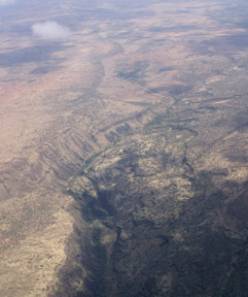
Great Rift Valley from the air.
The “airport” at the Mara was a thatched roofed hut without walls. Land Rover 4-wheel drive trucks took us to the campsite. There in the reception area was a sign informing us that our location was only 1° and 24 minutes south of the equator! Although it was mid-day, it was not stifling hot because of the many trees that provided shade, and also because we were at a high altitude.
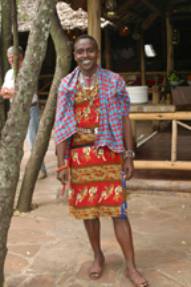
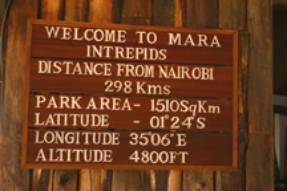
We were directed to our pre-assigned tents. There were no keys, because how can you lock a tent?
Because so many people wondered what it was like to live in a tent in Africa for 2 weeks (and I wondered too), I photographed our tent to show you.
Exterior of our tent.
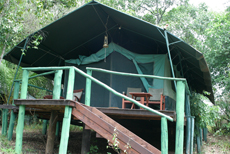
Ours was the only one with steps leading up to it because it was built on the crest of a hill overlooking the Talek River.

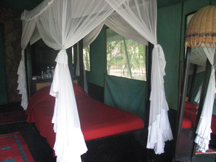
Looking in from the zipped door. My bed, full length mirror, 2 screened windows


Bathroom with sink and flush toilet. Other end of sink, towel rack and shower stall.
Our tent was on a hillside overlooking the Talek River. It was surrounded by a 3 layer electric fence. The animals were so accustomed to it, that they never came near it. At night we could hear the hippos in the river below. Other than birds and a couple of monkeys there were no animals in our campground area. One night a monkey got into our tent and stole a package of crackers off my desk, but that was not really a problem, and thereafter I left no food around.
Each evening while we were at dinner our beds were turned down for us, and a hot water bottle was laid at the foot!
Talk about luxury! The mosquito netting was also loosened to completely enclose the bed with a real mattress; not a cot.
Our bathroom had hot and cold running water, and a flush toilet as well as a shower. We had electricity from 5:00 AM till about 10:00 AM, and again from about 4:00 PM to 10:00 PM.
At our first meal at camp, I was impressed by the quality of the food, and its exceptional presentation. These cooks had made food service into an art form, and it was delicious besides. The dining “hall” was a long building with only one solid wall separating the eating area from the cooking area. All the rest was open, with only poles supporting the thatched roof. I wondered how people kept warm in the winter, and then realized that at 1° from the equator, there is no winter.
 |
n the late afternoon we had our first game drive, on which people go out in Land Rover 4-wheel drive trucks to an assigned area of the reserve to search for the bountiful wildlife. The 55 participants were divided into 5 groups of 11 people each, plus 1 leader; assigned by letter A, B, C, D, and E. There were 4 trucks assigned to each letter, and each person rotated each day within their letter to a different truck. This way we got to know at least 11 people, a good idea. |
The very first African wildlife we saw were 2 elephants grazing not far from our campsite. We didn’t stop there, but continued on to an ordinary-looking bush where our sharp-eyed driver had spotted a tiny bird known as a Little Bee Eater. They flew very fast, but would occasionally land on a branch where we could photograph them. I also have a number of pictures of branches where they used to be.
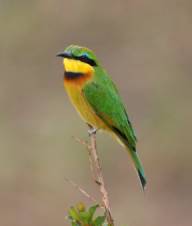
Little Bee Eater, Merops pusillus cyanostictus
A troop of baboons had come down to the Talek River, and we photographed them from a distance, and later found a pair close by.


Savanna Baboon, papio cynocephalus
Farther on we found the Wattled plover

African Wattled Plover, Vanellus senegallus lateralis
A large herd of zebras was grazing.

Plains Zebra, Equus quagga
The umbrella-like acacia tree standing alone in the open grassland typifies the savannah.
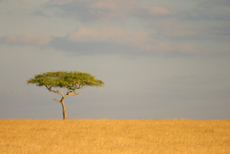
An elephant is the perfect animal to find in Africa. At the end of the day, the grass had become golden.

African Elephant, Loxodonta africana
Lions spend up to 23 hours a day resting, but even their yawns look ferocious.

Lion cub, Panthera leo
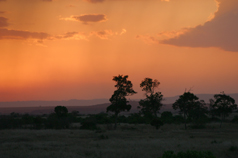
Africa is famous for its beautiful sunrises and sunsets.
This was only our first full day in the Mara, and we had already seen so much! What might other days have in store? At dinner that night, Joe VanOs announced that the Land Rovers would leave the following morning, and every morning at 6:00 AM sharp. If you were not there, you would be left behind. To my knowledge, nobody ever missed a game drive, although some people chose to skip them to sleep in, get caught up on writing or other things.
 Click to return to Main Menu
 Click here for the story of the following day
Click here to send Zoe an email.