
Wednesday, September 20
THE GREATEST NATURAL SPECTACLE REMAINING ON EARTH
 |
he greatest wildlife spectacle remaining on earth is the great wildebeest migration in Kenya/Tanzania. The herd consists of approximately 1.2 million animals, a recent high of numbers, which wanders through 10,400 square miles of Tanzania and southwestern Kenya; across the border to the Maasai Mara National Reserve in search of forage and water. |
The rains which had washed out our afternoon game drives, had set off the growth of the green grass, and thereupon triggered the age-old migration urge in the wildebeests. So powerful is this drive, that these animals MUST migrate. There is a major obstacle in their path, however: the Mara River. Some years the water level is low and the wildebeests can simply walk across, but all the afternoon rains this year had caused the river to become full with swiftly running water, so they would have to swim.
Earlier in our visit, some of the herd had begun their trek, and their river crossing; but now the main body of the wildebeest herd was upon us.
As before, no animal wanted to be the first one to test the water. Lions wait in the brush on both riverbanks, and crocodiles are waiting in the water. The only hope for the wildebeests and the zebras, which accompany them, is in their vast numbers – that there are so many, that others will be taken instead of them.
We must have waited for an hour for the first animal to enter the water.

You can see that the riverbank is rather steep at this point, but rather than look for a place with a gentler slope; the animals blindly follow the first animal, which successfully made the crossing. Notice the great number of animals waiting to cross at this narrow point. They push and shove one another in their eagerness to complete that all-important crossing and reach the green forage awaiting them on the far side.

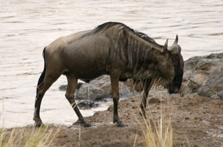
This exhausted animal has successfully made it.
At some points there must have been rocks or a sandbar in the river because the animals could stand and stop swimming.
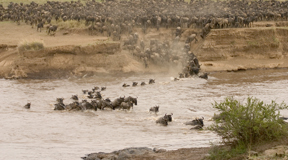
We moved several times to watch this migration, because the wildebeest herd had found several different crossing points. Sometimes they would stop using one position and move to another, and of course, we followed.
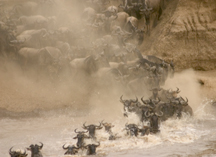
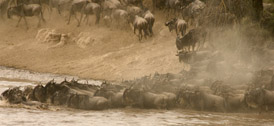
Things were working up to a frenzy now, with all the animals trying to work their way down the narrow passage to the river. Their hooves kicked up huge quantities of dust.

At a different point where the riverbank had a gentler slope, the animals just seemed to pour in with no sort of pattern at all.

The current was so strong in the middle of the river that the animals were carried downstream, and had to swim hard as they approached the opposite bank to get out at the landing spot.
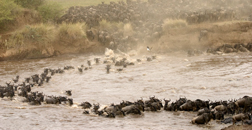
This calf had lost its mother and swam back across the river looking for her. It had lost its way and did not remember where to climb out.
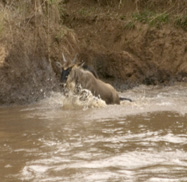
We counted 17 of these lost calves. Since they were old enough to forage for themselves, they had a chance to survive if only they stayed with the herd.
Although exhausted, some wildebeests kept right on running after safely leaving the river. Notice that this animal has all 4 feet off the ground.

Zebras often migrate with the wildebeests, but these had not; and it seemed to us that they were reluctant to cross on their own.

Sometimes the animals stopped crossing for some unknown reason, and awaited a leader to move them from one crossing spot to another.

Other wildebeests came to drink, but without a leader, would not venture into the water.

At last it was the zebras that jumped in and led the way across the river.

Then the wildebeests followed.

Pandemonium broke loose, as each animal suddenly realized that NOW was the right time for it to make its crossing! Immediately!
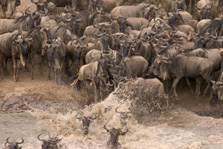
Wildebeests were leaping into the water, pushing, shoving, in what we would call a panic. Even though the riverbank was fairly low at this point, they all would enter the river only at the exact point taken by the first animal that made it safely.
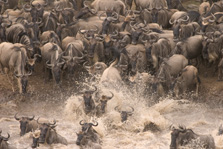
Some animals, however, were so worked up that they kept on running even when they had safely reached the opposite bank where we were watching.
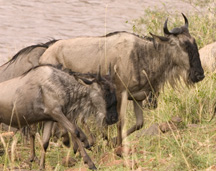
After the initial panic subsided somewhat, groups of other animals formed for their crossings. Since most of the predators had now had their fill of food, the danger was less than before, so the demand for immediate crossings was lowered. Some animals chose different places to cross and on his radio, our driver/guide could hear from the other guides where crossings were active. Of course, since they all spoke Swahili, we had no idea what they were saying. He would immediately start up our Land Rover and drive at great speed to that place so that we might watch also. It seemed each driver/guide was eager to give his passengers the best possible experience.

Having at last successfully completed their crossing of the Mara River, the wildebeests began happily grazing on the green grass, which those rainy afternoons had caused to sprout. They would remain here for the remainder of the dry season, until November/December when they would migrate again to the Ngorongoro Crater area where their calves would be born.

The herding instinct in wildebeests is very strong. Again, notice the dust raised by their many hooves.

Some animals would turn away to follow a different leader. The leader often chose a crossing place that was successful in the past; even if was not the easiest situation at present.
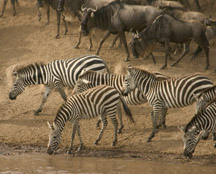
Zebras gathered together also. There were about 200,000 zebras in the area with their population holding steady; compared to 1.2 million wildebeests.
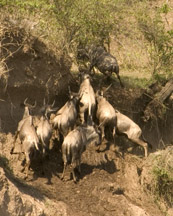
These calves had become separated from their mothers, and ran right through the zebras searching for them. Confusion was everywhere. They even swam BACK across the river in their search. Unfortunately they selected a particularly difficult area of riverbank to leave the river. We cheered when the last one made it up after a difficult struggle.
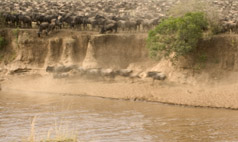
After all that, it was amazing that so many animals still waited to cross the river.
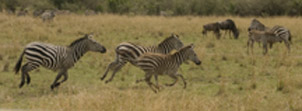
Once successfully on the Mara side of the riverbank, the zebras ran to indulge in the new green grass.
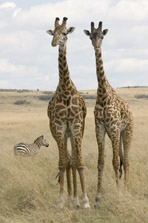
After such a spectacle, the sight of 2 giraffes did not seem so exciting at first, but this was a truly African scene with the zebras in the background.

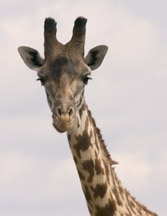
A giraffe portrait. These are Maasai giraffe, as shown by their white “socks”; no marks below their knees on their front legs.
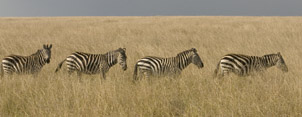
The zebras were still walking in line.
At lunch Joe VanOs announced that today was the first time he had ever tried to photograph while crying, so impressed was he at the immensity of the spectacle before us. He told us later he had been to Africa 8 times, but never saw anything like what we had witnessed. He is probably one of the most widely traveled photographers in the whole world, so this meant a lot. He called this morning’s experience the highlight of his life, which he will never see again, and he doesn’t care. I found myself very moved by his admissions, and hope I appreciated what I was looking at, while I saw it. Very few people alive have had this privilege, and I am grateful to have been one of them. All of us will remember our morning’s experience for the rest of our lives.
Because this was our last day at the Maasai Mara camp, many people were busy packing up for tomorrow morning’s departure home; so few took advantage of the very last game drive in Africa. I had most of my few items already packed, so I wanted my one last chance. As it turned out, I had a Land Rover and driver/guide all to myself. He even asked me where I wanted to go, or to look for, so I suggested birds. Richard said he liked birds too, and could identify everything that flies in the Mara. I believed him too.
Not far away we saw a Dik dik, a small antelope-like animal, seldom seen. I recognized it, because we have one at the Cleveland Zoo.


Kirk’s Dik dik Rhynchotragus kirkii
Richard drove down a 45-degree angle into what I thought was a stream. It was pretty scary, but he assured me it was safe with our 4-wheel drive vehicle. He did go slowly. He found a 15 foot crocodile on a huge rock, and I found a Goliath Heron on the far side of the rock in the Talek River. We have a Goliath Heron at the Cleveland Zoo also.

Goliath Heron Goliath ardea goliath
And so on the very last game drive of the very last day of my African adventure, I saw 2 new animals. How long could this have lasted? I do not know – shall I return to find out?
Richard also spotted a rare painted shrike hidden in some undergrowth. It was so well hidden, my photo did not come out well enough to include in this story.
It began to rain for the 6th consecutive day, thereby further nourishing the grass for the huge herds of grazing animals, so we drove up the opposite riverbank, (with me as the white-knuckled passenger) and returned to camp. I dumped all the beans out of my beanbag into the enormous 750 pound bag of beans which had been provided for us, and would now be given to the native people for food.
At our 7:00 PM dinner there was a parade of the Maasai Warriors singing and doing some dancing. Someone carried a huge birthday cake for all those who had had a birthday while on the trip. The warriors sang “Happy Birthday” to them all in Swahili, and then we sang it in our native language, which was mostly English. The 5 or 6 people who were so honored seemed pleased.
As I packed my few remaining belongings, it seemed like only yesterday, that I had explored the unfamiliar idea of living in a tent in Africa for 2 weeks. How daring it had all sounded! In reality it really was not daring at all, and I would not hesitate to recommend this experience to anyone I know, but not with small children.
 Click to return to Main Menu
 Click here for the story of the previous day
 Click here for the story of the following day
Click here to send Zoe an email.