
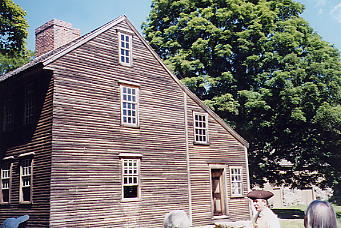
We drove to Concord to see the route that of the British soldiers on the day that started the Revolutionary War. Our first stop was the Hartwell Tavern. There is a 5 mile stretch of preserved land between Lexington and Concord called Minute Man National Historic Park. It preserves the Battle Road between the Merriam House and the Fiske House. Those Revolutinonary-era structures are still standing, as are several other buildings on the road. The Hartwell Tavern is a preserved structure. The British marched by it going to, and returning from Concord. The park rangers there dress in colonial costume, and talk about life at that time. The Tavern has most of its windows facing south, to welcome heat and light into the building. The long sloping roofline on the north face is supposed to ward off snow and wind during the winter. The Tavern had an indoor kitchen built as an extension onto the north side, which is why you can clearly see a dividing line between the original tavern and the kitchen addition. Inside the tavern are authentic furniture and clothing. It seemed like a MUCH nicer existence than the rude structures we saw at Plymouth Planation - but of course, Plymouth was 150 years before the Revolutionary War - strange to think that there was almost as much American history before the Revolutionary War as there was after it (I am comparing only timespans with this comment - 150 years vs 230 years - obviously the post_Revolutionary War era has so many additional people living in America that history measured in man years is much greater in post colonial rather than pre-colonial times.)
Hartwell Tavern included a demonstration firing of a Brown Bess gun, which was the weapon the British and the continental armies used during fighting. It is a muzzle loading weapon without rifling, it had a range of 80 yards or so. The park ranger demonstrated the 15 or so steps required to load and fire the gun. He said that expert soldiers would have been able to load and fire every 15 seconds, but his personal best time was about 20 seconds. My niece Heather volunteered from the crowd to act as sergeant - she read off each step, just as the commanding officer would have to his troops. You can see from the photo that there is a flash at the breech of the gun as well as a flash discharging from the muzzle. The weapon is fired when a pull on the trigger causes the flint to strike and create sparks. This ignites a small bit of black powder that is sitting in the firing pan, when the firing pan ignites, sparks will fly in all directions, including through a small hole in the gun barrel. This ignites the powder behind the bullet - it explodes and propells the bullet up and out the barrel. Sometimes the sparks from the firing pan failed to ignite the powder in the barrel, this misfire led to the phrase "A flash in the pan" - meaning a showy beginning, but no payoff performance.


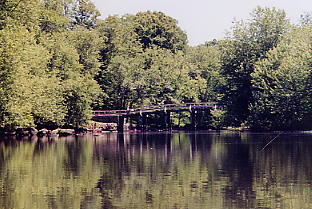
After a picnic lunch near Hartwell, Melanie and I decided to go canoeing. My mom asked to come along, as did two of my nephews: Sam and Ed. We rented two canoes at the boat launch at the Old South Bridge, and paddled our way north (downstream) to the Old North Bridge. The following two photos show the Old North Bridge from water level.

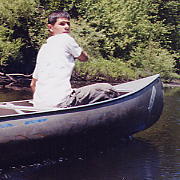
Ed and Sam demonstrated great speed when paddling their canoe, They zipped right up the river and out of sight.

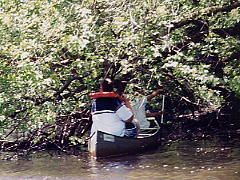
Although Ed and Sam paddled fast, their steering skills were not as impressive. Who put that tree in the middle of the river?
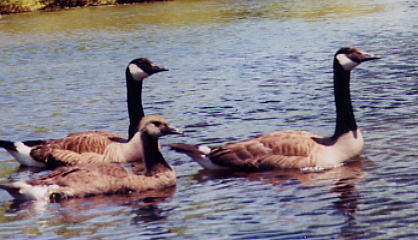
We saw some wildlife along the river. There is a wildlife reserve north of the Old North bridge, but we did not paddle that far.



After our canoe trip, we drove to the Old North Bridge. There is a monument to the Minuteman at the end of the bridge, this statue was erected 100 years after the start of the Revolutionary War. The British mission to Concord was two fold: they were to capture rebel rousers Sam Adams and John Hancock, plus, they were supposed to seize and destroy a cache of arms that the rebels had stored at Concord. The ride of Paul Revere alerted Adams and Hancock, who eluded arrest. Most of the arms were also moved. The British searched through the buidlings of Concord under strict orders not to antagonize the civilian population. The weapons that were discovered were set afire in the town square. The Minuteman militia, gathered outside of Concord, saw the rising smoke and assumed that the British had set the town on fire. The militia advanced upon the British troops that were guarding the Old North Bridge, and fired upon them. Two British soldiers were killed, and the British retreated. The redcoats regathered in the center of town, and began to march back to Boston. Colonial militia men came pouring in from all directions, and fired upon the British column all along the route. The Revolutionary War had begun.


We asked a local for directions a good ice cream store, and that ended our day in Concord.


