
Thursday, September 14
 |
romptly at 6:00 AM we left the campground in search of a suitable 6:15 sunrise. It was a particularly beautiful one today, with the acacia tree in just the right place. |

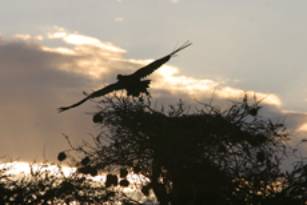
Just as we were ready to leave, a very large bird flew from its nest atop the tree. Did you notice the nest in the previous picture?
It was still so early that the Cape Buffalo were still sleeping in the grass. So tall was the grass that it almost hid their massive bodies, so that only their horns showed.

Soon one of them got up and surveyed the surroundings.

Zebras too began their day of grazing nearby.
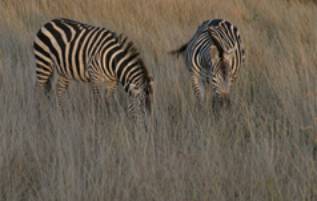
The savannah was coming to life for the day as well. Some zebras were grazing.
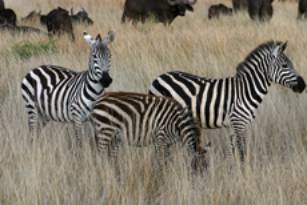
The brown zebra in front is a juvenile. His stripes will turn black and white as he grows.
As we drove along, we came upon a demolished ostrich nest.

Zebras and Cape Buffalo graze, as do “Tommies” and a warthog.
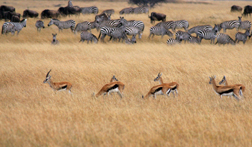
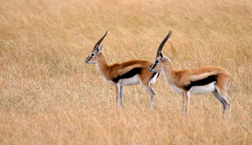
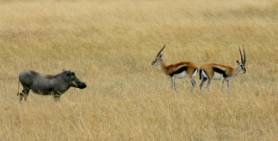
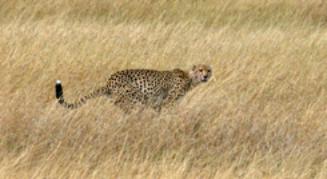
The Tommies graze, and then become alert to danger, some run away, others stand their ground. Then one of the remaining two gazelles left as well. What did they see? Can you spot the cheetah stalking in the tall grass? They did.

From a crouch, suddenly the cheetah explodes into full attack speed. The fastest land animal on earth, a cheetah can reach 45 miles/hour, but only for a short time. She must therefore, get close to her target before bursting into “attack speed.” If she is too far away, it is possible for her prey to outrun her. In 4 out of 5 attacks, the cheetah goes hungry. The cheetah bunches up all 4 of her paws while running. Notice that none of her paws is touching the ground.

Then she stretches out to her full length. This ability is what gives her her legendary speed. This picture was taken at 1/500 of a second at f 11 and 400 ISO and is still blurry.

The gazelle runs at top speed, zig zagging as best he can. But the outcome is predictable. This time the cheetah wins, and kills her prey by strangling it. At this point, the gazelle was still kicking occasionally.
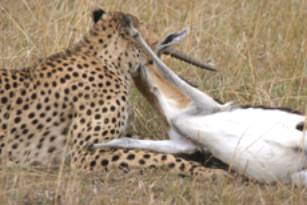
She must eat quickly because scavengers will come from miles around to steal away her meal.
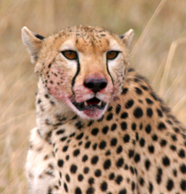
Trouble first appears as a Lappet-faced Vulture.

Lappet-faced Vulture, aegypius tracheliotus
The Lappet-faced Vulture is the largest African vulture with the largest beak of any kind of bird of prey. It is the strongest and most dominant vulture at kills. At a fresh kill, other vultures wait for this one to arrive. With its massive bill and great strength it opens the hide enabling all to feed.
The more common white back vultures, both immature and adult, follow closely.

The cheetah tries to drive them off, but they return as quickly as she settles down to eat. There are more vultures than carcass and as they fight for space, still more vultures arrive.

Outnumbered, the cheetah slinks away. Her six cubs will not have the full meal she intended.
After such a spectacle, it would take quite a bit to get us excited again, but a male lion in the bushes did so.

We noticed some vultures at their nest and stopped to photograph them.
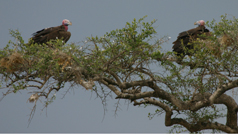
These Lappet-faced (Nubian) vulture fledglings will probably fly soon.
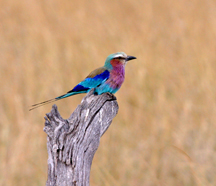
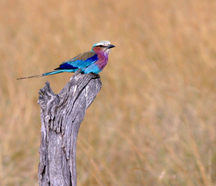
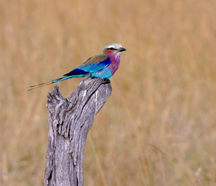
The lilac breasted roller is considered by many people to be the most beautiful bird in all of Africa. Since I heard this before leaving, I had hoped to be able to see and photograph one of them. Just driving down a path, our driver stopped by one on the stump of a dead tree. Of course, we jumped for our photo equipment and set up as fast and quietly as possible.
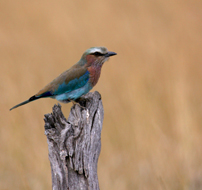
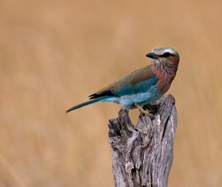
This bird was a juvenile without the long tail for which rollers are noted.

Lilac-breasted Roller, Coracias candata
Several photos later, it was joined by a parent. Soon the parent returned with a grasshopper, which it fed to the juvenile.
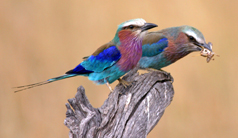

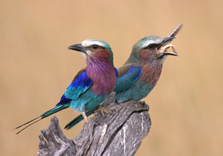
The chick really wanted the food, and would not give up.


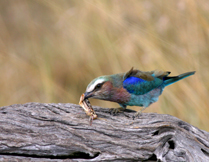
It was difficult to determine which was winning - the bird or the grasshopper.

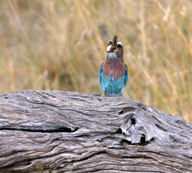
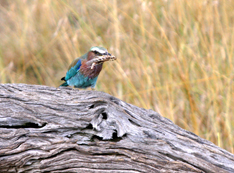

Success at last!
The adult returned to watch.
We saw a topi and a Coke’s hartebeest standing together.

I believe it was the only time we ever saw the hartebeest.

Topi,Damaliscus lunatus
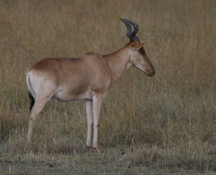
Hartebeest,Alcelaphus buselaphus
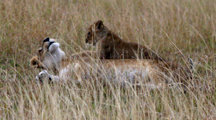
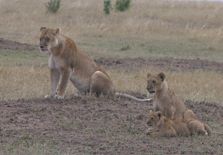
A lioness was watching over several cubs. It was not unusual for one female to care for all the cubs of a pride while the other females rested or hunted.




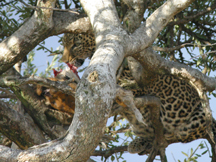
The only leopard we saw was in this tree, where it had dragged an impala it had killed.
 Click to return to Main Menu
 Click here for the story of the previous day
 Click here for the story of the following day
Click here to send Zoe an email.