
Wednesday, September 13
 |
e left promptly at 6:00 AM today to search for a good place to watch the sunrise. On our way we met a hippopotamus returning to the river after a night of grazing. It needs the water to support its great bulk, and to protect it from the sun. |
A Thomson’s gazelle was awake also.

When we found our sunrise viewpoint, I realized that other Cape Buffalo were silhouetted against the brilliant sunbeams. What a beautiful example of Africa!

Off we went to discover what the day would bring. Soon our driver pointed out an African Ground Hornbill, and pulled up near it.
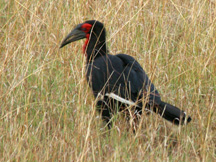
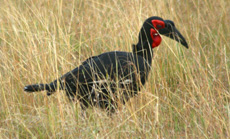
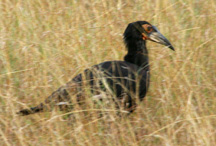
Southern Ground-Hornbill, Bucorvus cafer
This hornbill walks up to 7 miles a day, but will fly across territory unsuitable for walking. It takes most food on the ground, digging with its bill deep into the soil for prey that has run into holes. It flies to grass fires to capture fleeing creatures.
Farther on, we met a hippo returning to the river, or perhaps the same one we saw earlier.

A Morning With The Elephants
|
e came upon a herd of elephants grazing peacefully, and parked to watch them. |
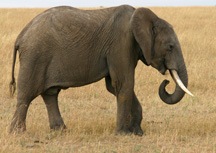
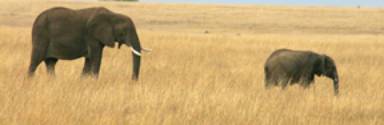

This elephant passed so close to our truck that I felt I could have petted it.
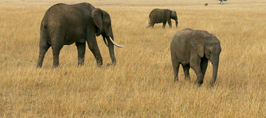

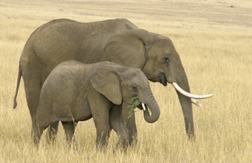
Baby elephant, and baby elephant with mother
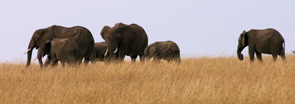
At last the herd walked off over a small hill.
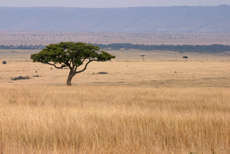
What does the savannah itself really look like? It is very open rolling grasslands with an acacia tree here and there. It is a semi-arid landscape.
A topi is often seen standing on a termite mound, as this one is. The additional height gives him a better position as a lookout for the herd.
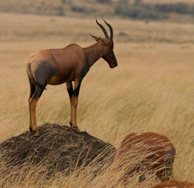
Topi Damalisscus lunatus
The topi is built for speed and endurance, with high shoulders, deep chest, and long trim legs
Mara River Crossing
 |
ne of the last greatest wildlife spectacles on earth is the migration of the wildebeests in Africa. The high point of the journey for onlookers is their crossing of the Mara River, which stands between them and the greener grass they know awaits them on the other side. |
The wildebeests gathered on one riverbank in great numbers waiting around and jostling while watching for the first animal to cross. This was far more serious than it first appeared. Waiting in the bush along the riverbank on each side were hungry lions, well aware of the great amount of moving food. In the river swam the hungry crocodiles, as well as other predators, awaiting a bountiful food supply.
When we arrived the first animals had already made it safely across, followed by a line of other animals. The launch point was quite narrow, however, but no animal dared to try another route. They continued to follow one at a time.
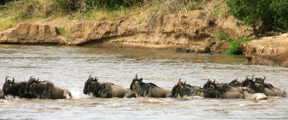

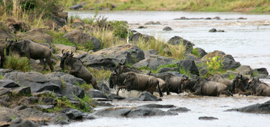
Finally some of the later animals lost their patience and began running and leaping over the earlier animals, landing with huge splashes in the river; sometimes landing on top of other animals and breaking their backs.
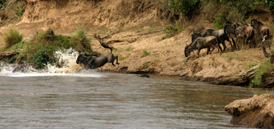
This animal was especially graceful.
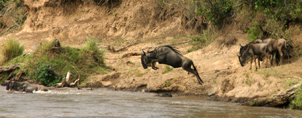
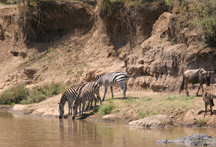
There were so many people, that the animals eventually stopped crossing, being more afraid of the crowds of people than the lions and crocodiles. Some zebras came to drink at the river, but without a leader, would not jump in to cross. The driver/guides tried to get the tourists back into their vehicles hoping that the animals would begin to cross again, but they did not. The people could not see from where their vehicles were parked and complained loudly. The drivers drove away, and soon our drivers did also.
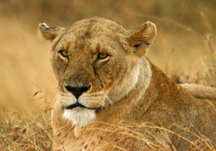
A lioness sits quietly in the grass.
During our afternoon drive it began to rain hard. We replaced the rooftop pieces, and kept looking. We were rewarded with a good view of the saddle-billed stork, standing perfectly still in a stream, waiting to catch its dinner. Our driver positioned the Land Rover parallel to the stream. We slid back the windows on the side away from the rain and photographed through the open window.
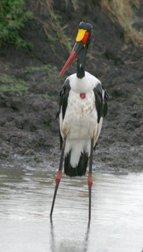
Saddle-billed Stork, ephippiorhynchus senegalensis
This stork is one of Africa’s most attractive birds. The yellow portion of its bill is the “saddle.” The bare red “medal” on its white breast is normal.
It was raining so hard we were glad to return to camp. There would be no sunset photography tonight.
 Click to return to Main Menu
 Click here for the story of the previous day
 Click here for the story of the following day
Click here to send Zoe an email.