
Tuesday, September 12
 |
ot far from our camp we came upon a female elephant with young. This was one of the few animals in the Mara Reserve who did not tolerate our presence well. She began to flap her ears, and our driver warned us she was becoming impatient. I was all for leaving at once, but the others wanted to stay and eventually the adult moved off, followed by the young. |
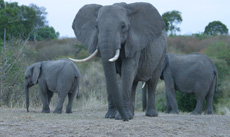
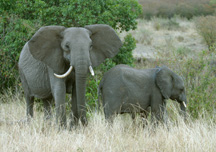

Stressed elephant flaps her ears and moves her feet.
Later we found and followed the spotted hyena back to her den where her 2 cubs were playing.


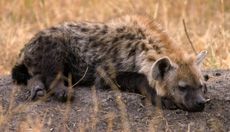
Spotted Hyena,crocuta crocuta
The hyena at her den with her two cubs. The spotted hyena is capable of running down and killing a bull wildebeest, and hyenas in packs kill zebras and even larger prey. The alpha female is the biggest and best-fed member of the clan.
This particular kill had become a popular place. In addition to the vultures, a warthog passed through.
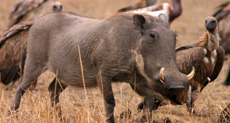

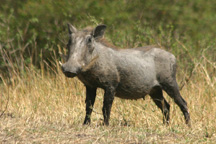
Warthog,Phacochoerus africanus
Near the edge of the crowd was this unidentified vulture.
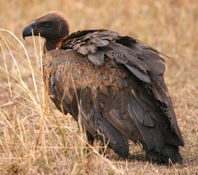
Is this an immature white-backed Vulture?
Later on we found these 2 lionesses doing what they do most of the time – resting. They seemed undisturbed by the many flies on their faces.


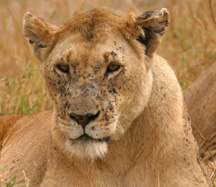
Young lions, doing what they do most of the time – resting.
Another kill had been fairly well demolished by these white-backed vultures, a common bird in Africa.

White-backed Vulture,gyps africanus
Africa’s most common large vulture.
A Maribou Stork appeared at the kill site, which surprised me, because I did not realize storks could be scavengers.Its wingspan is exceeded only by the two condors and the largest albatross.
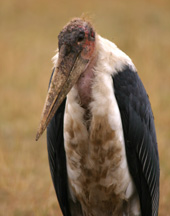
Marabou stork, Leptoptilos crumeniferus
Described in one bird guide as an enormous ugly bird
As evening approached, our guide called our attention to a secretary bird, which I thought looked most unusual.
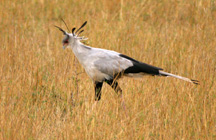
Secretary bird, Sagittarius serpentarius
Not all stories on the savannah have happy endings. This zebra has escaped with an injury to its hind leg. If it cannot fight or run very fast, it will soon become another victim.
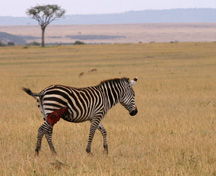
Injured Zebra
A Morning With Giraffes
 |
frica is noted for its giraffes, and we were fortunate to see a great number of them today. Perhaps our segment of the park was where they have chosen to live. |
Most people have seen a giraffe or two at a zoo, but here in the wild, we were able to observe a great number of them together. They have a strange, running gait, but can move very quickly nevertheless.
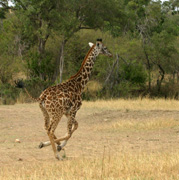
Giraffe, Giraffa camelopardalis
A Giraffe is a pure browser able to reach leaves 19 feet from the ground. They drink every few days when water is available. They have a long prehensile tongue.
Giraffes are noted for their lovely eyelashes.
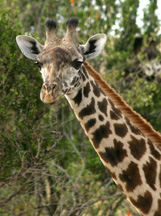
To get a full portrait of a giraffe, you must not too stand close, or else use a wide angle lens.

Sometimes male giraffes will push at each other’s necks in a test of dominance. Here it appears that they are only standing in position with their necks overlapping.

“Necking” giraffe-style.
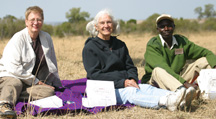
By mid-morning we were very ready for our “box breakfast” with Uluru, our guide.
We were fortunate to see this male ostrich, a very large flightless bird, related to the Australian emu and the South American rhea.

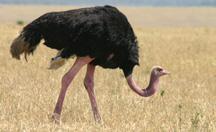
Ostrich,Struthio camelus
The ostrich is a huge flightless bird. The male can reach 9 feet and the female just over 6 feet in height. A territorial male usually has a “major hen” and several “minor hens.” Often eggs from more than one female are placed in the same nest. The ostrich is the largest and heaviest living bird. It is the fastest-running bird and can maintain up to 30 mph for 30 minutes, or 45 mph for short distances. Its strides can be eleven feet long.
Afternoon With Wildebeest and Lions
 |
he warthog is considered by many people to be the ugliest animal of all. It serves a purpose, however, to provide food for many carnivores. |
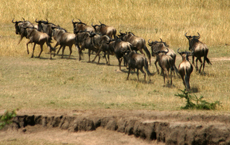
Another animal lacking in beauty, but valuable for the balance of wildlife is the wildebeest, also known as the gnu to crossword puzzle fans. Its spindly legs carry it surprisingly quickly, but it is its great numbers, that are the basis of its value. It is the wildebeest migration which is the last great nature spectacle remaining on earth. As they march, they can mow a field of grass from knee to ankle height within a week. When they march it is usually in single file.
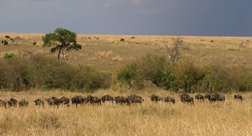
It is somewhat unusual to see a solitary wildebeest at migration time, because their herding instinct is so strong.
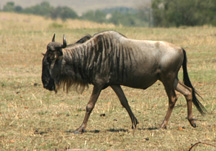
Wildebeest, connochaetes taurinus
These two zebras were grazing warily. They were uneasy because they were aware of the lioness on the other side of these bushes.


And the wildebeests marched on, sometimes with a few zebras.



These three pictures of the wildebeest herd are all cropped from a single gigantic panorama photograph. The size of the original photo is 56 inches wide by 8 inches tall.
It was now late afternoon about 5:00 PM, and the sky was rapidly darkening as a storm approached. Still the wildebeest continued to march.
The Cape Buffalo have been feeding in a grove of trees. They are huge and powerful animals.
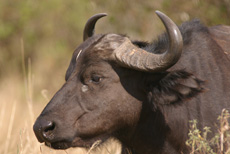
Cape Buffalo (African Buffalo), Syncerus caffer
The most sociable of its species, the African Buffalo forms herds of up to several thousand animals that pack closely together, and cooperatively protect herd members.
The storm was getting closer now, dominating the whole sky.

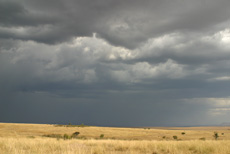
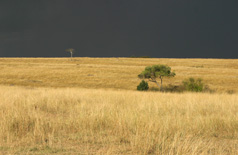
The African plain sky and grass.
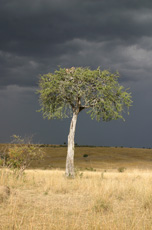
A single tree stood in front of the storm.
Our guide had spotted a vulture nest in the tree top.

African Vulture nest
The oryx are beautiful animals.

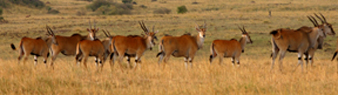
Oryx (Gemsbok), Oryx gazella
The oryx has the ability to survive in places without water. It subsists on coarse desert grasses, and digs up roots and bulbs to fulfill its water needs.
At the end of the storm was a lovely rainbow.

A lone lioness surveys her territory.

Another lioness watches over cubs playing. Not all of them are hers. One or two lionesses will sometimes watch the cubs of an entire pride of lions.
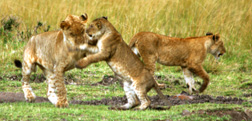
These lion cubs at rough and tumble play, just like the kittens they are.
A juvenile lion. Lions are born with stripes and spots to camouflage them from predators. As they grow, the markings disappear.

Another magnificent African sunset.

 Click to return to Main Menu
 Click here for the story of the previous day
 Click here for the story of the following day
Click here to send Zoe an email.