

by
Zoe Enyedy

 |
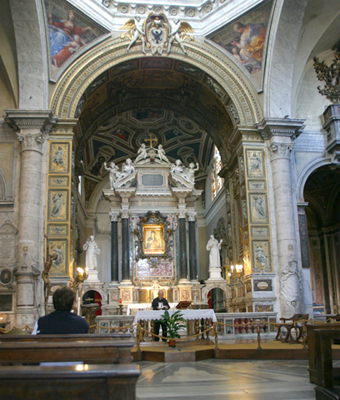
e went on a “discovery walk” one day. The Piazza del Popolo was our first destination where we found twin churches, built in the late 17th century. The one on the left in this picture is Santa Maria in Montesanto; on the right is Santa Maria dei Miracoli. We went into one of them and found a lovely altar. There was also an Obelisk in the Piazza. |

Santa Maria in Montesanto and Santa Maria dei Miracoli

Obelisk at Piazza Popolo
Despite some construction in the area, we enjoyed the lovely fountains in the Piazza del Popolo, which was designed by Valadier (1816-20).
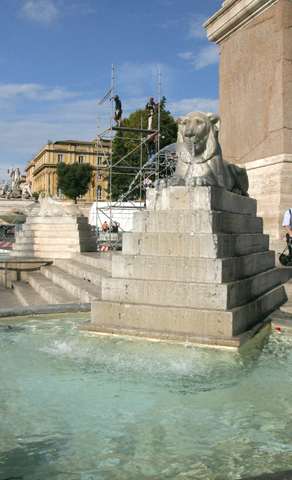
Fontana dell'Obelisco, at the base of the obelisk

Fontana del Nettuno, at the eastern end of Piazza del Popolo
At the top of a small hill, known as the Pincian, we found a Gargoyle on a rooftop, carefully on guard.

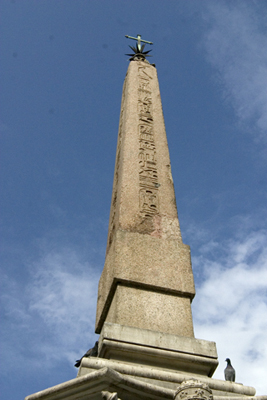
An obelisk was here, but it was Roman; not Egyptian. It was commissioned by the Emperor Hadrian and erected in Tivoli for the tomb of his friend Antinous. It was moved to Rome to decorate a circus. In the 16th century it was found and moved first to the Palazzo Barberini, and then to the Vatican by Pope Clement XIV; finally erected on the Pincian by Pope Pius VII in 1822. It stands over 27 feet high.


The Obelisk on Pincian Hill
Along a path from Pincian Hill to the Spanish Steps was a different view of the Vatican and Rome, and a bit farther, some bougainvilla outside the French embassy.

Distant view of the Vatican, looking across Rome from the Pincian Hill

French embassy
At the top of the Spanish Steps in Trinita dei Monti, we found another obelisk. This one was a smaller copy of one originally commissioned by Ramesses II. It was erected in 1789 by Pope Pius VI, and the last of the great obelisks raised in Rome.
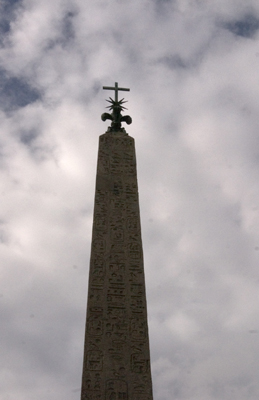
The Obelisk standing at the top of the Spanish Steps
Also at the top of the steps was the Church Trinita dei Monti Pieta designed by Wilhelm T. Actermann.
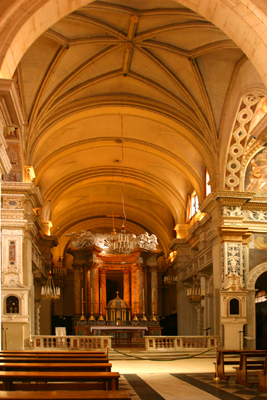
Interior of Trinita dei Monti Pieta
We came to the Spanish Steps, named for the Spanish Embassy to the Vatican, which has been here for over 300 years. The 137 steps are especially beautiful in springtime, when they are decorated with colorful azaleas. They are a favorite meeting place for romantics, locals and tourists.
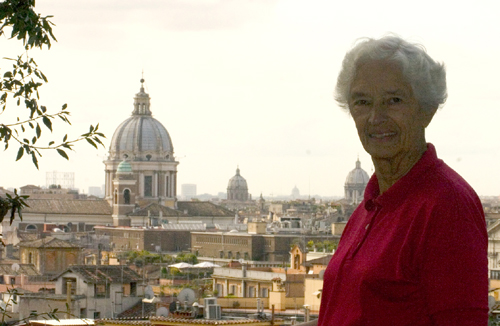
I'm standing at the top of the Spanish Steps

Looking up at the Spanish Steps

Looking down the Spanish Steps
At the foot of the Spanish Steps is the “Sinking Boat Fountain” (1627-29) by P. Bernini, the father of Gian Lorenzo Bernini. It has no spray because it depends on water pressure for its water supply. Pope Urban VIII restored an ancient Roman aquaduct to bring water to the fountain.

Just off the bottom of the Spanish Steps was the church of St. Andrew delle Fratte, a place of peace and quiet, and great beauty.

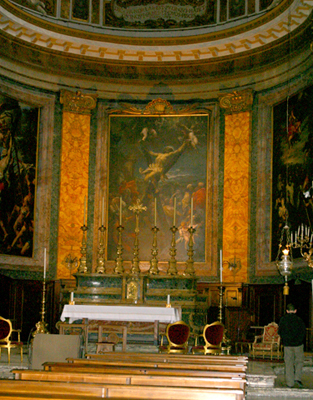


Interior of Sant' Andrea Delle Fratte
This obelisk dates from the reign of Pharoh Psammetichus II in the 7th century BC. The Roman Emperor Augustus had it brought to Rome and placed in a huge square as a sundial where its shadow indicated the hours of the day, and day of the year. It was found in 1748 in 5 pieces, and repaired, but the reliefs were partly lost. It stands now in the Palazzo di Montecitorio, where it was erected by Pope Pius VI in 1792.

Nearby, we came to the column of Marcus Aurelius. Marcus Aurelius’s Column still stands where it was built, in honor of the Roman Emperor Marcus Aurelius. Since most of the people of that time were illiterate, pictures were used as a means of communication. The column consists of 28 blocks of marble carved as a continuous spiral picture in relief, telling the story of Marcus Aurelius’s victories. It was completed in 193 AD. In the 16th century, the statue of Marcus Aurelius was replaced by one of St. Paul.

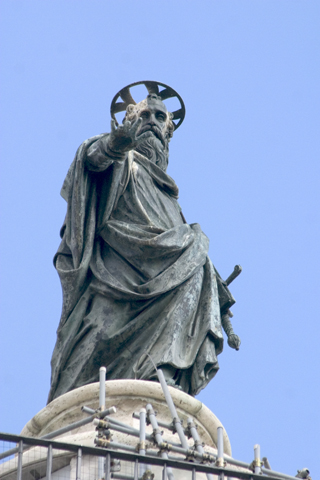

Column of Marcus Aurelius
We continued walking and found an obelisk from the time of the Great Egyptian builder, Ramesses II. It originally was one of a pair at the temple of Ra in Heliopolis. It was found in 1373 near San Macuto and erected east of Santa Maria on Capitoline Hill. It was moved to the front of the Pantheon by Pope Clement XI in 1711 over a fountain by Filippo Barigioni.


The Trevi Fountain
 |
he Trevi Fountain (1732-62) is considered to be one of the most beautiful fountains of all. Its name comes from the meeting of three (tri) streets(via). It was designed by Nicola Salvi (1732) under Pope Clement XIII, and completed by Giuseppe Paneni. It is found in the Piazza di Trei. Its famous basin was built with money collected from taxes collected on wine. Its world-famous legend has it, that if you toss a coin over your left shoulder with your right hand, you will return to Rome, so of course, I tried it also. These coins amount to about €120,000/year, most of which goes to charities. |
The central figure is Neptune, and below are two Tritons struggling with 2 sea horses: one calm, the other bucking, to represent the sea in its various moods. The bubbling and gushing water re-creates the ocean’s power and turbulence. These central figures were begun by the little known Giovanbattista Maini, but were finished by Pietro Bacci. The figures in the niches represent Abundance on the left, and Health on the right; both by Filippo Valle.
As the terminus of the Aqua Virgo Aquaduct, the Trevi Fountain is also one of Rome’s several mostre d’acqua, a term meaning that it had the pressure to push the water onward to other outlets.


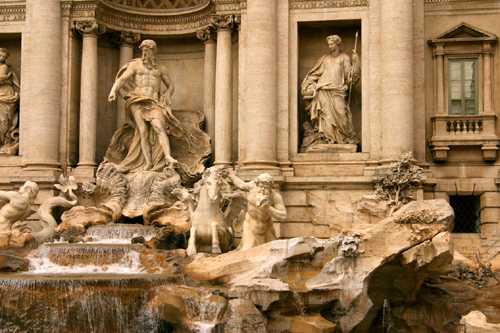
The Trevi Fountain
Church of the Gesu
 |
t was becoming late in the morning, and we knew that the Church of the Gesu closed to the public shortly after noon, so we hurried in that direction. |

Exterior of the Church of the Gesu
The mother church of the Jesuits in Rome is considered the first fully baroque church, and influenced ecclesiastical building in Rome for more than a century. It was consecrated in 1584, but not decorated for another 100 years. It was originally intended to be left plain to the point of austerity; but when completed it was fabulously decorated with a fantastically painted ceiling by Baciccia.

Painted ceiling inside the Church of the Gesu
Lapis lazuli and gold were in abundance all around this beautiful church.


The ornate baroque interior of the Church of the Gesu
Santa Maria Sopra Minerva Church
 |
opra means over, and this church is built over an earlier church from the 8th century amid the remains of a pagan temple built in 50 BC by Pompeii and probably dedicated to the Roman goddess of war, Minerva. The statue of Christ Bearing His Cross by Michelangelo is here. Michelangelo originally sculpted Christ as naked, but later prelates decided on greater modesty and a bronze “loincloth” was added. |

Christ Carries His Cross by Michelangelo
St. Catherine of Siena, who convinced the Popes to return from exile in France, is buried under the main altar.

Santa Maria Sopra Minerva interior

Saint Catherine's tomb beneath the altar
There are other side altars around the church as well. This is Rome’s only Gothic Church, and the principal church of the Dominicans.

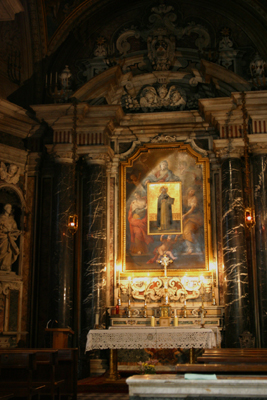
Altars inside Santa Maria Sopra Minerva
In front of the church is an interesting obelisk, about 15 feet high. Originally it was one of a pair brought to Rome by the Emperor Diocletian for the Temple of Isis. It was found in 1655 and erected in 1667 by Pope Alexander VII behind the Pantheon Piazza della Minerva. It was placed on an Elephant base designed by Bernini and sculpted by his pupil Ferrate in 1667.


The obelisk on the back of Bernini's elephant
The Pantheon
 |
ome is built right around the walls of antiquity. Instead of tearing down the old structures, they simply build new structures around, or over them. The Pantheon is among the best preserved buildings of antiquity in Rome. |
The Pantheon is one of the Wonders of the Ancient World, entirely rebuilt by Hadrian around 120 AD on the site of an earlier Pantheon erected in 27 BC by Agrippa, Augustus’s general. The building was designed by Hadrian. Until 1960, the Pantheon’s dome was the largest ever built . The harmony of the building is illustrated by the diameter of the dome, which equals its height. The 27 foot diameter opening in the top of the dome called the “oculus,” lets in light. A drainage system below the floor removes the water when it rains. The oculus was called “the all-seeing eye of heaven.” The 5000 ton weight of the concrete dome is concentrated on a ring 30 feet in diameter, which is the oculus, the only source of light.
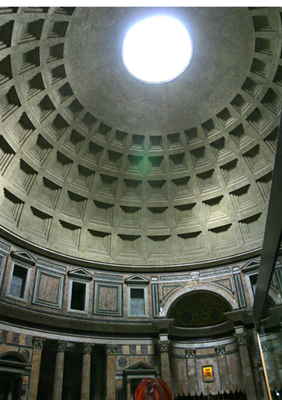
In 609 the Byzantine Emperor Phocas gave the building to Pope Boniface IV who converted it to a Christian church. The building’s consecration as a church saved it from abandonment, and destruction which befell the majority of ancient Rome’s buildings during the early medieval period. The bronze tiles were stripped off the roof mostly (90%) for the cannon fortification at Castel Sant’Angelo. Much fine external marble has been removed over the centuries. Today it is a Catholic church.

Original columns from 125 AD during the reign of Emperor Hadrian - known from date stamping on bricks
The circular shape of the building allows for a number of altars and monuments.

MADONA OF THE ROCK - so called because her foot rests upon a boulder

Raphael's Tomb

A beautiful angel statue
Another survivor from antiquity is the obelisk, originally ordered by the great builder, Egyptian Pharoah, Ramesses II as one of a pair for the temple of Ra in Heliopolis. In 1373 it was found near Santa Maria in Aracoeli on the Capitoline. In 1711 it was moved to the front of the Pantheon by Pope Clement XI over a fountain by Filippo Barigioni. It is a little over 18 feet tall.

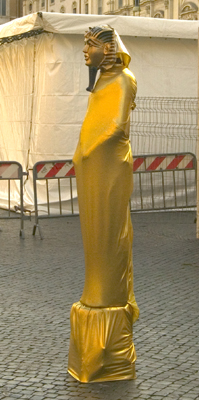
In several places around Rome, were people dressed and spray-painted in metallic paint standing statue-still, collecting money for some cause. This particular person had added a golden mask from Egypt.
The Fountain of Four Rivers was under construction in Piazza Navona, but the obelisk above it was ordered to be copied by Domitian. It was erected on top of the fountain by Bernini in 1651.

Ponte Sant’Angelo leading over the Tiber River to Castel Sant’Angelo is lined by copies of angels by Bernini. Two of the spans are originals from Roman times - still in use.


In 590 A.D. the Archangel Michael appeared above the mausoleum to Pope Gregory the Great, sheathing his sword, indicating the end of a plague. Castel Sant’ Angelo became a fortified palace, renamed for the “holy angel.”

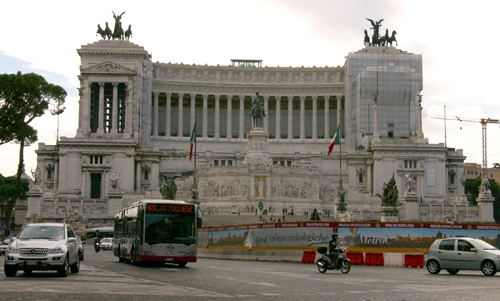
Victor Emmanuel Monument
|
his monument was built to honor the unification of the many Italian city-states into one country. The first king was Victor Emmanuel II. People disliked this monument, calling it a huge wedding cake, or an oversized typewriter. |
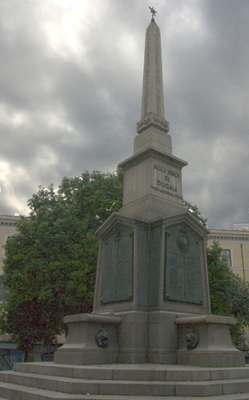
This obelisk was originally one of a pair from Heliopolis, Egypt. The other is now is in the Boboli Gardens in Florence. It was found in 1883 near Santa Maria sopra Minerva. It now commemorates the Battle of Dogali with names of Italian soldiers. At first it was in front of the train station, but has now been moved to its present site. It took us a long time to find it.

St. John Lateran Church
|
t. John Lateran Church is called the “Mother and first of all Churches of Rome and of the World” because it is the Cathedral of Rome. |
The Basilica of Saint John Lateran dates back to the first centuries of Christianity, when the Popes chose the Lateran as their residence. They remained there until 1305 when they were exiled to Avignon, France for 70 years.

The St. John Lateran basilica, the Church of Rome

The nave of St John Lateran
Like St. Peter’s and St. Paul’s, this Basilica was also founded by Constantine who granted the Pope property to go with it. It was dedicated to both great saints named John: the Baptist and the Evangelist. Little remains of the original Basilica, which underwent many restorations over the centuries. The Vandals did serious damage in 455, and an earthquake in 896 caused more damage. It was rebuilt, but seriously damaged by fire in 1308 and in 1360.

Statue of Constantine who gave this land to the church
The main door dates from the Roman times, its bronze wings come from the Curia Ostilia, the seat of the Roman Forum. The wings were placed here after the architect Borromini, commissioned by Pope Innocent X, who restored the interior of the Basilica in the 16th century, added a frame that brought them to the dimensions of the Basilica’s door.

The original doors to the basilica
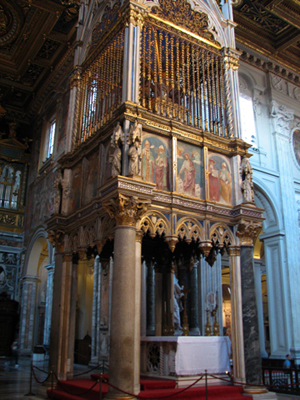
The High Altar contains the Tabernacle that was built in 1367 under Pope Urban V by the elegant Sienese artist Giovanni di Stefano. It is decorated with 12 fresco panels from the period. Relics of St. Peter and St. Paul are kept in the upper part.

The tabernacle

Crucifix in Saint John Lateran
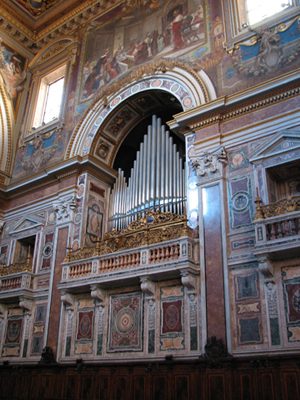
Elaborate paintings surround the pipe organ

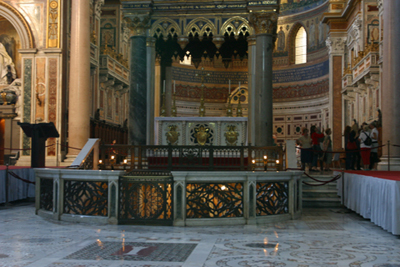

The high altar
The most impressive sight to me was the enormous statues along the main aisle set into niches of green marble. While not as large as St. Peter’s, St. John Lateran is a fabulous church with many outstanding works of art, and definitely worth your time to visit there.
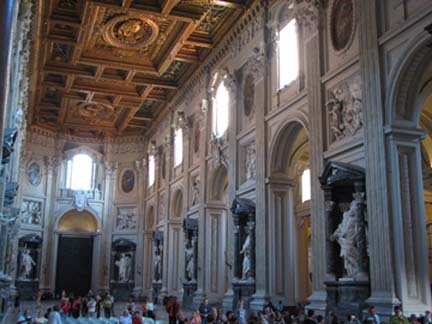
The twelve niches in the church were empty until the early eighteenth century, when Pope Clement XI held a competition to see who could deliver the best sculptures of the twelve apostles.


Bartholomew, Philip, and James the Lesser


Thomas, James the Greater, and Andrew


Matthew and John
By now, we had learned to look up at the ceilings, and this one also was magnificent.


The decorated ceiling
Even the floors were worthy of note. Different patterns of marble were in different areas of the church.
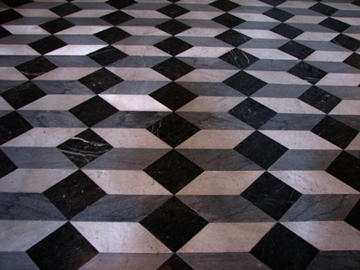

Beautiful marble mosaic floors
As we turned to leave, we were impressed by the inside of the entrance.

The main doors to St John Lateran
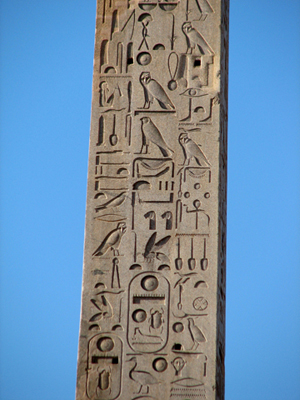
Directly outside St. John Lateran’s Basilica we found the Obelisk of Piazza di San Giovanni in Laterano, the tallest obelisk in Rome, and the largest standing ancient Egyptian obelisk in the world. It weighs over 230 tons. Built originally by Pharaohs Tuthmosis III and Tuthmosis IV for the temple of Amun in Karnak, it was brought to Alexandria with another obelisk by Constantius II, and brought on its own from there to Rome in 357 to decorate the Circus Maximus. It was found in 3 pieces in 1587, restored about 12 feet shorter by Pope Sixtus V, and erected near the Lateran Palace and Basilica of St. John Lateran in 1588.

The Scala Sancta
 |
irectly across the street was The Scala Sancta (Holy Staircase). After yet another adventuresome street crossing, we arrived at the place that tradition identifies as the staircase of the Praetorium of Pilate in Jerusalem, which Jesus climbed during His passion. Around the year 335, St. Helen Constantine’s mother decided to go to Jerusalem to find the Cross of Jesus. Among the relics she brought back was this staircase. It has 28 marble steps, now recovered with wood for protection, while small glass sheets cover some spots that are considered to be a trail of Christ’s blood. |


By tradition, Christians climb the staircase on their knees to the top, which ends at one of the most venerable monuments of history and art of the Medieval Ages, the Sancta Sanctorum. The attentions of the visitor concentrate mostly on the famous table of the Redeemer, a precious icon that has been dated to the 6th century.

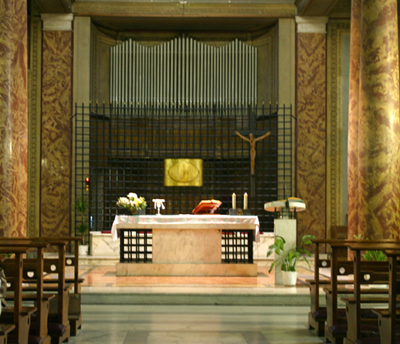
Pope Pius IX must have contributed something to this place because this statue of him is found there.

In keeping with the holy staircase, there is a statue “Ecce Homo,” by Giosué Meli (1874). Pilate’s words “Behold the Man” as he presented Jesus to the crowd of people on Good Friday, and said he found him innocent of crime. This is near the entrance just before a person would begin to climb the staircase.
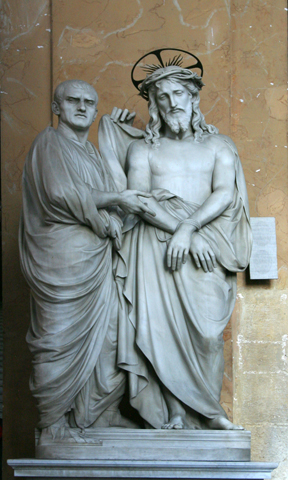
"Behold the Man"
Saint Peter in Chains Church
 |
lease remember that this is NOT St. Peter’s Basilica. It is some distance at the top of a very steep hill. There are 2 primary attractions here: Michelangelo’s statue of Moses, and the chains that legend claims held St. Peter when he was imprisoned in Jerusalem. According to legend: when Pope Leo I compared them to the chains of St. Peter in the Mamertine Prison in Rome, the two chains miraculously fused together. They can be seen today preserved under the main altar in the basilica. |

The chains which could not hold Saint Peter
This church was built in 432-440 to house the relic of the chains, and has been restored several times.
Michelangelo’s Moses, which was completed in 1515 was originally intended as part of a massive 47-statue, free-standing funeral monument for Pope Julius II. Michelangelo completed only Moses and 2 women, Leah and Rachel, before the Pope died. After that, there was not enough money to complete the project and no one was interested enough in it to contribute.
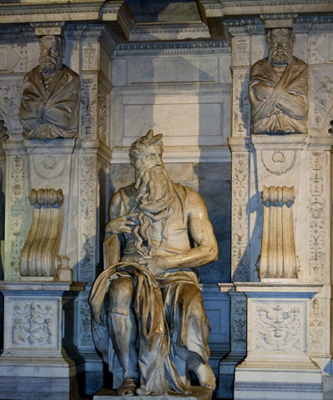
Moses, by Michelangelo
Moses is shown with horns rather than beams of light because it was easier to sculpt horns than beams of light. In Hebrew, rays of light and horns, sound very similar. The people of that time, would have recognized the meaning of rays of light; and would have never thought that Moses had horns.
The Return Home
|
t was hard to realize that our Italian visit had come to an end, and that it was time to pack and go home tomorrow. This had truly been an experience of a lifetime, and one that I will always remember. |
Roseann’s and my flight left early, whereas Art and Melanie’s flight left several hours later. We had to get up at 4:00 AM to make connections with the train that would take us to the airport in time to catch our Al Italia flight to Amsterdam where we would pick up a Continental flight to New Jersey, and then another Continental flight to Cleveland.
We got up on time, and noticed that Art also was up, even though he had 3 more hours of sleep to enjoy. He had generously planned to come with us to the airport to be sure we got on the right train and plane flight! He helped me with my camera bag, and one lone carry-on bag, helped me onto the proper train, and helped me to the proper place at the airport! And then he had to go all the way back to our apartment, and repeat the whole procedure with Melanie, 3 hours later! What a generous son! He never even hinted that he was going to do this – he just showed up and helped! I am so richly blessed with such a son, and so grateful!
Because Roseann and I did not have a means of contacting Al Italia while in Rome, we were unable to request a seat assignment together before boarding. The gate agent assured us that our reservation would be honored, but because the flight was already full, we could not sit together for the flight to Amsterdam. From there to Cleveland, we already had the seat assignments which I had arranged before leaving. So I was given a left-over odd seat of 3 in F22, and Roseann had the last row on the plane. We would not complain. Almost the last passengers to board stopped at row F and said I was sitting in one of their seats, which was F22. I told them that I had been assigned this seat by the gate agent, and Roseann in the last row had the ticket with my seat assignment on it. They went to the last row and returned with Roseann, and a flight attendant. The flight attendant examined their tickets and then my ticket, all of which were in order. The airline had sold the same seat twice over. The flight attendant said “This is a completely full flight, with no seats left at all in this class. May I re-seat you in seat A-1? It’s first class.” I didn’t mind at all, needless to say. Roseann asked me to wait for her when we landed, rather than getting off and getting lost. The flight attendant reached down my bag and escorted me to seat A-1, which was much, much nicer than the one I had given up.
My seatmate in A-2 told me he was a doctor from Bahrain, returning home after some sort of meeting. He spoke excellent English all the way to Amsterdam – I think he just wanted someone to listen to him. Part way through the flight, I heard the flight attendants saying “I don’t know what else to do; shall we ask if there is a doctor on board?” Sure enough, very soon they did announce that if there were a doctor on board, please identify yourself. My seatmate did, and left quickly. After a while, he returned and said a young man could not be roused, so he helped to bring him around. The young man did not speak either English or Bahrainian (or whatever they speak) so someone who could speak to his companion translated into English, and then back to whatever the young man needed. With that accomplished, the doctor continued to talk to me all the way to Amsterdam.
The funniest part of all this, happened when we landed in Amsterdam and passengers began to deplane. Everyone around us had listened to the conversation between the flight attendant and me, and commented on it as they got off “So, how was the flight up front?” “Did you have a good flight?” and other variations. I actually enjoyed it.
There was little time to explore Amsterdam Airport, so we just went to International Departures, found our Continental flight and got on. Our flight across the Atlantic was unremarkable, we landed in Newark, NJ; and found our correct flight to Cleveland. The Terminal Tower has always symbolized home to me, and our Italy Adventure was over when I saw it.
Pete met Roseann, and Adam and Marty met me to take me home all the way across town. I was much too tired to attempt it myself. I did remember that Suz, my daughter-in-law, had been working on repapering my living room-dining room while I was away while also running Roseann and Pete’s Heating/Air Conditioning Business by day. What would I find?
My astonishment almost knocked me over! I scarcely recognized my own home! Suz had done such a beautiful total make-over!!! In addition to the lovely new wallpaper, she had re-arranged the furniture as she replaced it, and in the process added 2 more feet visually to the living room! (I hope my neighbor doesn’t mind). Suz had matched the pattern of the wallpaper perfectly, so that there are no seams at all; she had replaced the electrical switch plates (which needed it badly) and it looked like a whole new house!!! I almost wondered if I actually lived here. A year later, I am still admiring her work, seriously.
I am so richly blessed to experience such wonders and kindness, and I do appreciate it. The whole experience from the very beginning was filled with special events and once-in-a-lifetime experiences. It is a joy to share them with you, dear reader, with the hope that you may enjoy it through my pictures and words.
 Venice